
On 1 October, Ampol agreed to buy Evie Networks for $225 million, fully debt funded. With its own AmpCharge network, it would hold about 1,424 public charging bays across more than 400 sites, which Ampol says is the largest network in Australia by bays.
It is a sensible move by a fuel retailer facing a shift in what its customers drive. But a good strategic move and a good investment are not the same thing.
Is this a good investment, or investing for the future?
What Ampol is actually buying
Ampol is not really buying chargers. It is buying sites, grid connections and time, which are much harder to replicate.
Evie brings well-located metro and highway sites, leases averaging about 10 years, established grid connections and roughly 20 MW of spare grid capacity at some sites. Ampol says that grid access “will become increasingly valuable as BEV adoption accelerates.” It also brings about 380,000 registered customers and a fit with Ampol's fleet fuel card business.
The price looks fair because buying costs about the same as building. Ampol's own rollout of 74 fast-charging stations, completed in March 2026, cost $53.8m for 15.6 MW of capacity, about $3,400 per kW. Evie costs about $3,600 per kW and comes with grid connections, leases, customers and utilisation already in place.
Ampol has not disclosed what Evie earns today. There is no revenue, EBITDA or earnings multiple for Evie, only a target for the combined business. That is not unusual for a private company of this size, but it means the price can only be judged on assets, not earnings.
The utilisation test
Utilisation, the electricity each bay sells in a day, decides whether charging makes money. Evie's bays averaged 117 kWh a day over its financial year to June 2026, 134 kWh in June and 142 kWh in September. With about 61 kW of capacity per bay, 142 kWh is the same as each bay running flat out for about 2.3 hours a day.
To hit $30m of EBITDA, the combined network of about 1,424 bays needs to earn about $21,000 a bay each year. At a margin of 20c to 30c per kWh, that is at least 190 to 290 kWh per bay per day, or 1.4 to 2 times Evie's current level. The margin is measured at the site, before head office and network operations costs, so the real bar is higher.
Each Evie bay needs to sell at least 1.4x to 2x as much electricity to hit the target
Electricity sold per charging bay, per day (kWh)
That lift is within reach, although it leans on an EV sales surge partly driven by the fuel shock (risk 4 below). The margin is the least certain input. Evie publishes its prices, mostly 60c to 77c per kWh including GST, but not its costs, so the margin is benchmarked to EVgo and Fastned.
What the global benchmarks say
There is no Australian benchmark for charging returns, so the closest references are two listed fast-charging specialists, EVgo in the US and Fastned in Europe.
The sites make money. The companies barely do.
| Latest reported | Energy per charging space, per day | Average spaces per site | Site-level margin | Company EBITDA |
|---|---|---|---|---|
| Evie | 142 kWh in Sept 2026 (117 average over the year to June 2026) | ~3 | Not disclosed | Not disclosed |
| EVgo, US | 276 kWh (Q2 2026) | ~4 | 36.1% (1H 2026) | Minus A$26m (1H 2026). 2026 guidance is a loss of A$7m to A$36m |
| Fastned, Europe | ~230 kWh (Q1 2026) | ~7 | 50% (1H 2026) | A$22m (1H 2026), after expansion costs |
Ampol investor presentation, EVgo Q2 2026 results, Fastned 1H 2026 results and Q1 2026 trading update. A$ at RBA rates, 13 October 2026. Compares one vehicle charging at a time.
The sites make money but the companies barely do. In the first half of 2026, Fastned's stations earned A$60m, but the company earned A$22m once the cost of building new stations is included. EVgo lost A$26m. Ampol's target includes network expansion, so it will carry the same kind of cost. And about a third of the target, $10m, comes mostly from cost synergies rather than charging growth.
Evie's sites are also small. A Fastned station has more than twice the charging spaces of an Evie site and sold more than three times as much electricity a day. Rent, network charges and maintenance are fixed per site, so adding bays at existing sites matters as much as lifting utilisation.
Hitting the target is not the same as paying for itself
Even if Ampol hits its target, the combined charging business earns an economic return of roughly 1.5% to 5% pre-tax on the capital involved.
The capital base is the $225m price plus Ampol's existing Australian charging assets of about $35m, roughly $260m before any expansion. On that base, $30m of EBITDA is an 11.6% cash yield, which looks respectable until the chargers need replacing.
Even at target, the return is 1.5% to 5% pre-tax
| Charger life assumed | Annual capital recovery | Pre-tax economic return on ~$260m |
|---|---|---|
| 10 years (matches Evie's lease tenure) | ~$26m | ~1.6% |
| 15 years | ~$17m | ~4.9% |
Kinetik estimates on $30m EBITDA. Capital is the $225m price plus about $35m of existing Australian charging assets.
A better question is when the deal earns its keep. Assuming an 8% pre-tax hurdle, the business needs roughly $38m to $47m of EBITDA. Growing at the “double-digit” rate Ampol promises from about $30m around 2030, it gets there in roughly 2033 to 2035.
Why 8%? The deal is fully debt funded. Ampol's accounts imply a pre-tax cost of debt of about 6%, and its weighted average cost of capital, the test Ampol itself uses, is higher still. So the dates above are the earliest case.
More telling, at target and after providing for replacing its chargers, the business makes about $4m to $13m a year. Interest on the $225m alone is about $14m a year. On a 10-year charger life the business falls well short of that. On 15 years it only just covers it.
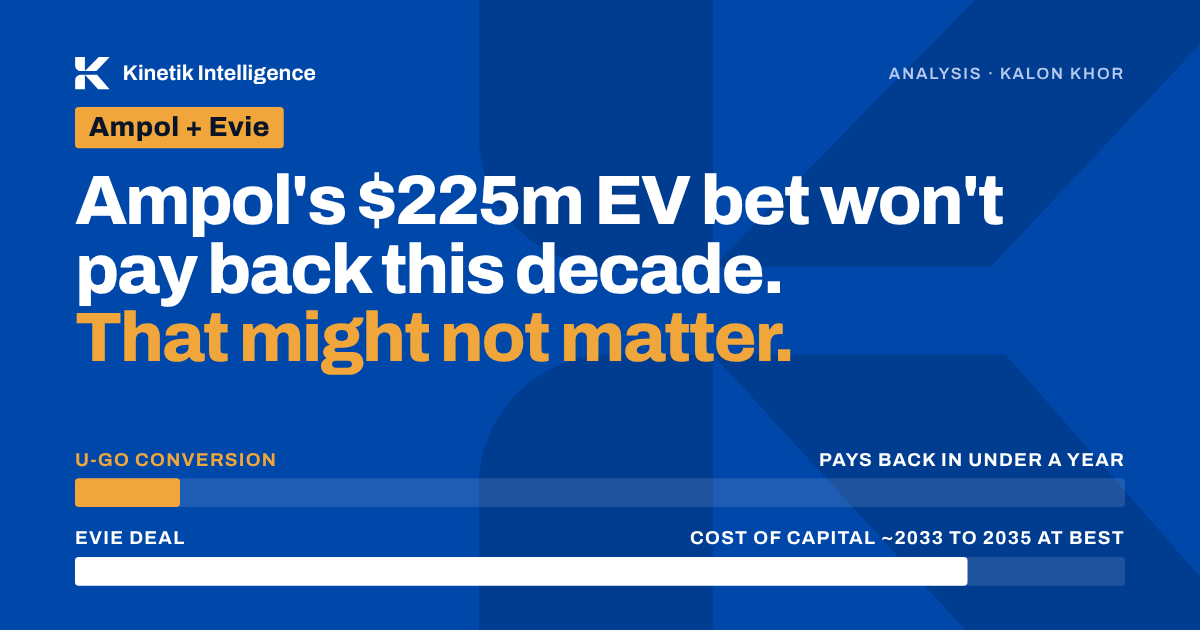
Even on Ampol's own targets, this deal does not pay for itself this decade.
Four risks the presentation doesn't dwell on
- Most of Evie's chargers are slow. 62% of its DC chargers are rated 50 to 75 kW. Upgrading them will take capital that is not yet visible in the target.
- Network tariffs punish success. Evie told the AER that DC tariffs “penalise utilisation”. Sites selling more than 160 MWh a year are moved onto larger network tariffs, which Evie says “materially worsen” site economics.
- The lead is narrow. On Ampol's own chart, the combined network has 1,424 bays against Tesla's 1,230 and Chargefox's 1,175, a lead of about 16%.
- Record EV sales were helped by record petrol prices. Battery EVs reached a record 24.9% of new car sales in August, up from 8.3% in 2025, as the Middle East conflict pushed petrol to record highs. With cheaper models arriving and petrol still elevated, there is no doubt this has accelerated EV adoption. The question is where sales settle once prices ease. That decides the growth rate behind Ampol's “double-digit” target.
None of these breaks the deal. Together, they explain why the return arrives late.
Two speeds of capital
The most revealing comparison is inside Ampol. As covered in my previous piece, U-GO conversions lifted fuel volumes 64% across 47 sites with “modest capex, and less than 1 year payback”, according to Ampol's first-half 2026 results.
Evie, on the numbers above, takes a decade or more. The fuel business will fund the EV business for years.
Kinetik ViewStrategically defensible, at a fair price, with returns that won't arrive until the 2030s.
Judged as an investment, this deal falls short. Ampol is buying a position, not earnings. Even at target, once the chargers are provided for, the business at best only just covers the interest on the debt that funds it.
Judged as an investment in the future, it is defensible. Well-located sites with grid access are hard to replicate, and Ampol expects them to become more valuable as EV adoption grows. The downside is capped, with a price that is small against the $1.64b of RCOP EBITDA Ampol earned in the first half of 2026 alone. And every driver who switches to an EV is a fuel and shop customer Ampol could otherwise lose.
Public fast charging in Australia still does not stack up on its own. This deal positions Ampol for the point where it does.
What to watch
- Energy per bay. The single number that decides the deal. Evie is at 142 kWh a day and the target needs at least 190 to 290.
- EV sales after the fuel shock. Whether the EV share holds above 20% of new car sales once petrol prices ease.
- Charger upgrades. How quickly the 50 to 75 kW fleet is replaced, and what it costs.
- ACCC clearance, expected in the first half of 2027, and any conditions attached.
Method and sources
Figures are from company filings and calculations are Kinetik estimates. Returns are economic, recovering the ~$260m over 10 to 15 years. Ampol's $59.1m of charging assets covers 494 bays in Australia and New Zealand, so the Australian share is estimated at about $35m by bay count. Cost of debt is first-half 2026 interest on borrowings, annualised, over average borrowings. The margin band applies EVgo's 36% and Fastned's 50% site margins to Evie's published prices before GST. Benchmarks compare one vehicle charging at a time. Currency at RBA rates, 13 October 2026.
Sources are Ampol's ASX release and investor presentation (1 October 2026), first-half 2026 results and half-year report, FY2025 results and 2025 annual report. Also Evie's AER submission (January 2026) and published prices, ARENA's project data for Ampol's charging rollout, EVgo's Q2 2026 results, Fastned's first-half 2026 results and Q1 2026 trading update, and FCAI monthly new car sales.
Disclaimer: The views and conclusions expressed in this article are my own independent professional opinions based exclusively on publicly available information and observable market data. No confidential, proprietary or non-public information obtained through any current or former employment has been used. These views do not represent those of any current or former employer and do not constitute investment advice.